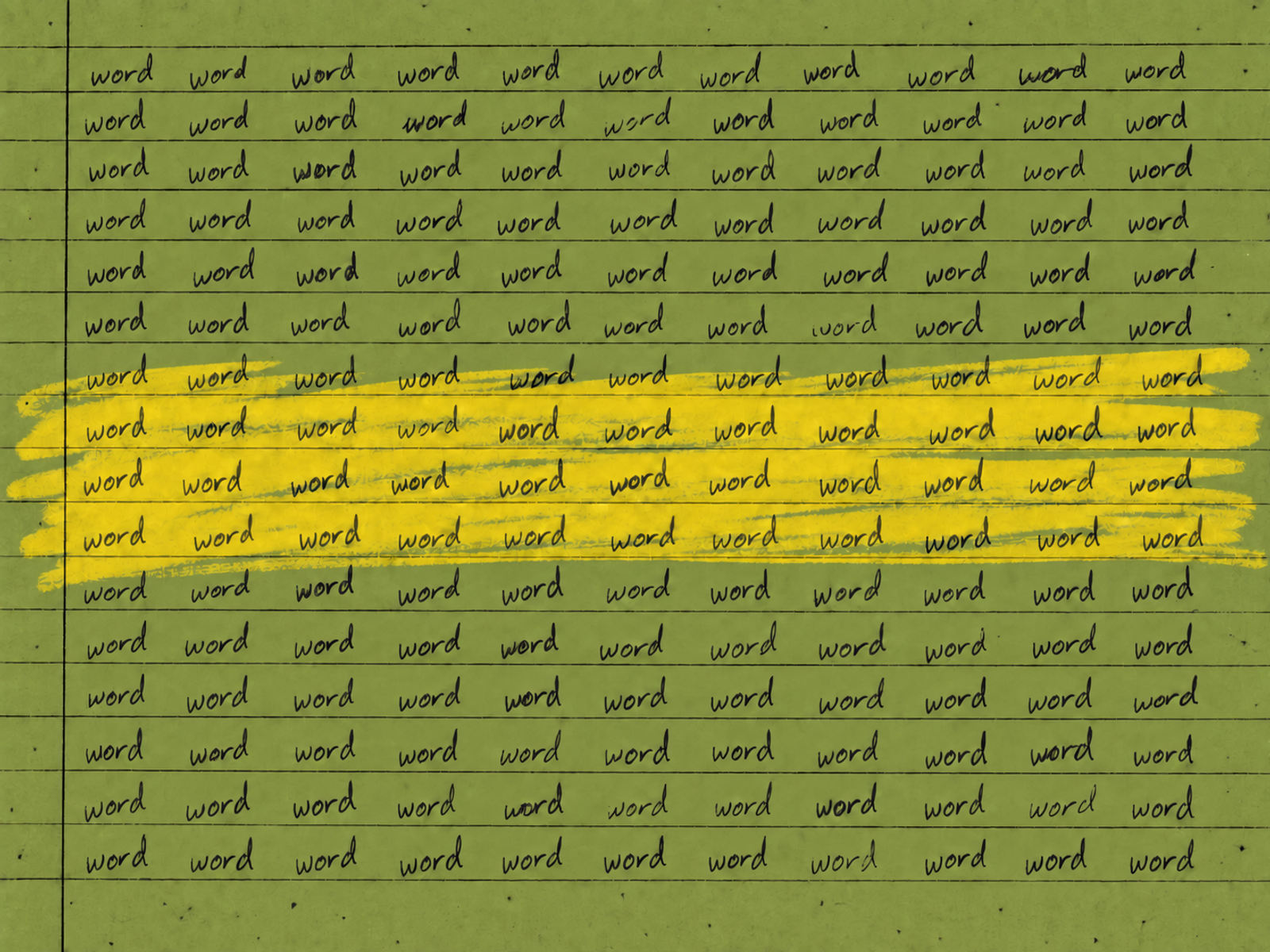
A word said once can be a statement. But what happens when you keep repeating it?
Human beings have always been suspiciously interested in repetition. We count rosary beads, recite prayers, repeat affirmations, and chant at sporting events. The word eventually stops behaving like ordinary language. It becomes a rhythm. Breath. Vibration. Something felt before it is understood.
Before mantra became a wellness word
The Sanskrit word mantra is commonly translated as an instrument or tool of thought. It is traditionally used to focus the mind and create a mental anchor of awareness.
In early Vedic traditions, mantras were sacred utterances used within ritual. They could invoke a deity, accompany an offering, preserve religious knowledge, or help produce the intended effect of a ceremony. Their importance did not depend only on what the words meant. The sound, meter, pronunciation, sequence, and person reciting them mattered too. It was part of a larger system of practice.
Over centuries, mantra developed across Hindu traditions and became central to Buddhist, Jain, Sikh, and tantric practices as well. Some mantras took the form of prayers or names. Others were short syllables whose significance could not be reduced to an ordinary dictionary definition.
The sacred syllable Om, for example, has carried different meanings and functions across Indian religious traditions. It has been used as an invocation and a sacred sound. Its history stretches through Vedic texts and later philosophical traditions. Harvard Divinity School’s Center for the Study of World Religions traces this history through ritual, sound, Sanskrit texts, and modern yoga.
Not every repeated sentence is a mantra
Today, mantra is regularly used to describe any phrase a person likes to repeat. Commonly used Sanskrit mantras in the yoga world, aside from “Om”, are: “Sat nam”, “Om Shanti”, and “So Hum”. Mantras are not limited to the Sanskrit language. We can use them in English. You may have heard the following used: “Love”, “I am present”, “Gratitude”.
There is nothing inherently wrong with a repeated personal phrase. Words can organize attention, interrupt habitual thinking, and remind us of what we intend to practice. But historically, a mantra and an affirmation are not exactly the same thing. An affirmation usually makes a claim. It asks the mind to rehearse an idea about the self, the future, or the world.
A mantra may contain a comprehensible statement, but it does not always operate by trying to make the mind believe something. In many traditions, the sound itself is the purpose. The practitioner is participating in a ritual relationship between sound, attention, breath, memory, devotion, and repetition.
An affirmation says, “Here is what I want to believe.” A mantra may ask, “What happens to my mind when I repeat this?” Both can be meaningful. They are not always interchangeable.
“Repetition slowly moves language out of the analytical mind.”
Meaning is not always the point
Western culture tends to treat language as merely a form of communication. Words carry meanings from one person to another. Mantra gives sound a larger job.
A sacred utterance can communicate meaning, but it can also create an experience through its rhythm and vibration. Some mantras name or praise a deity. Some condense an entire teaching into a few syllables. Some are treated as sonic manifestations of the sacred rather than descriptions of it.
This is why translating a mantra does not necessarily explain what practicing it feels like. You can translate the lyrics of a song and still fail to explain why the chorus makes someone cry. The literal meaning matters. So do the associations, memories, breath patterns, inherited rituals, and physical sensations attached to the sound.
Repetition slowly moves language out of the analytical mind. The words may remain meaningful, but they also become muscular. The tongue knows where to go. The breath learns the phrase. The body begins to anticipate the next sound. Eventually, you are not only thinking about the words. You are reacting to them.
Repetition gives the mind fewer places to travel
The mind produces language constantly. It narrates, rehearses, predicts, reviews, judges, and creates imaginary conversations with ourselves. Mantra does not stop this machinery by force. It gives the verbal mind one deliberately limited assignment. Repeat this. When attention wanders, return to this. When another thought appears, return to this. The word becomes an active anchor. Unlike trying to think about nothing, which can quickly become a daunting task, repetition occupies part of the mind’s language system.
What science can and cannot tell us
Scientific research can study attention, stress, mood, brain activity, and physiological changes associated with mantra-based meditation. It cannot determine whether a sacred sound connects a practitioner to divine reality. That question belongs to a different system of knowledge.
A 2022 systematic review and meta-analysis found that mantra-based meditation was associated with small-to-moderate reductions in anxiety, depression, stress, and post-traumatic stress symptoms. The authors also noted important limitations, including risk of bias, relatively few studies involving clinical populations, and limited long-term follow-up. The complete review is available through the National Library of Medicine.
How to practice
You do not need to claim a lineage you do not belong to or pronounce a Sanskrit phrase you have never researched. Begin with context. If you want to practice a traditional mantra, learn where it comes from, what it means, how it is pronounced, and whether it is intended for open use. Some mantras are widely practiced. Others are traditionally received through initiation or instruction.
If you want to experiment with repetition itself, choose a simple word or short phrase you understand. Sit somewhere reasonably quiet. Let the breath remain natural. Repeat the phrase silently or aloud for five minutes. You can use mala beads, your fingers, or a timer. When another thought appears, notice it and return to the phrase. Do not attempt to force the word into feeling profound. Notice what actually happens.
Does its meaning become stronger or weaker? Does it begin to sound strange? Does your breathing change? Does the phrase become irritating? Does the mind grow quieter, or simply invent more creative distractions? The irritation is not failure. It may be the first moment you notice how strongly the mind resists being given only one thing. The more your mind resists the quiet, is a signal that you should keep leaning in.
The word changes because we do
After enough repetitions, a word can temporarily detach from its usual meaning. Linguists call this semantic satiation. A psychological phenomenon where repeating a word continuously causes it to temporarily sound like meaningless noise.
“Door. Door. Door. Door.”
Soon it is less a word and more a very odd noise humans have collectively agreed to understand. Mantra uses repetition differently, but it enters the same strange territory where a word can become both less ordinary and more intimate. Its surface meaning may soften while its sensory, emotional, or spiritual associations deepen.
A mantra gathers significance through use. The hundredth repetition is made of the same syllables as the first, but it is spoken by someone who has now spent ninety-nine times listening to it. Repetition does not force a word to become true. It gives the mind fewer places to go while we listen for what the word says.