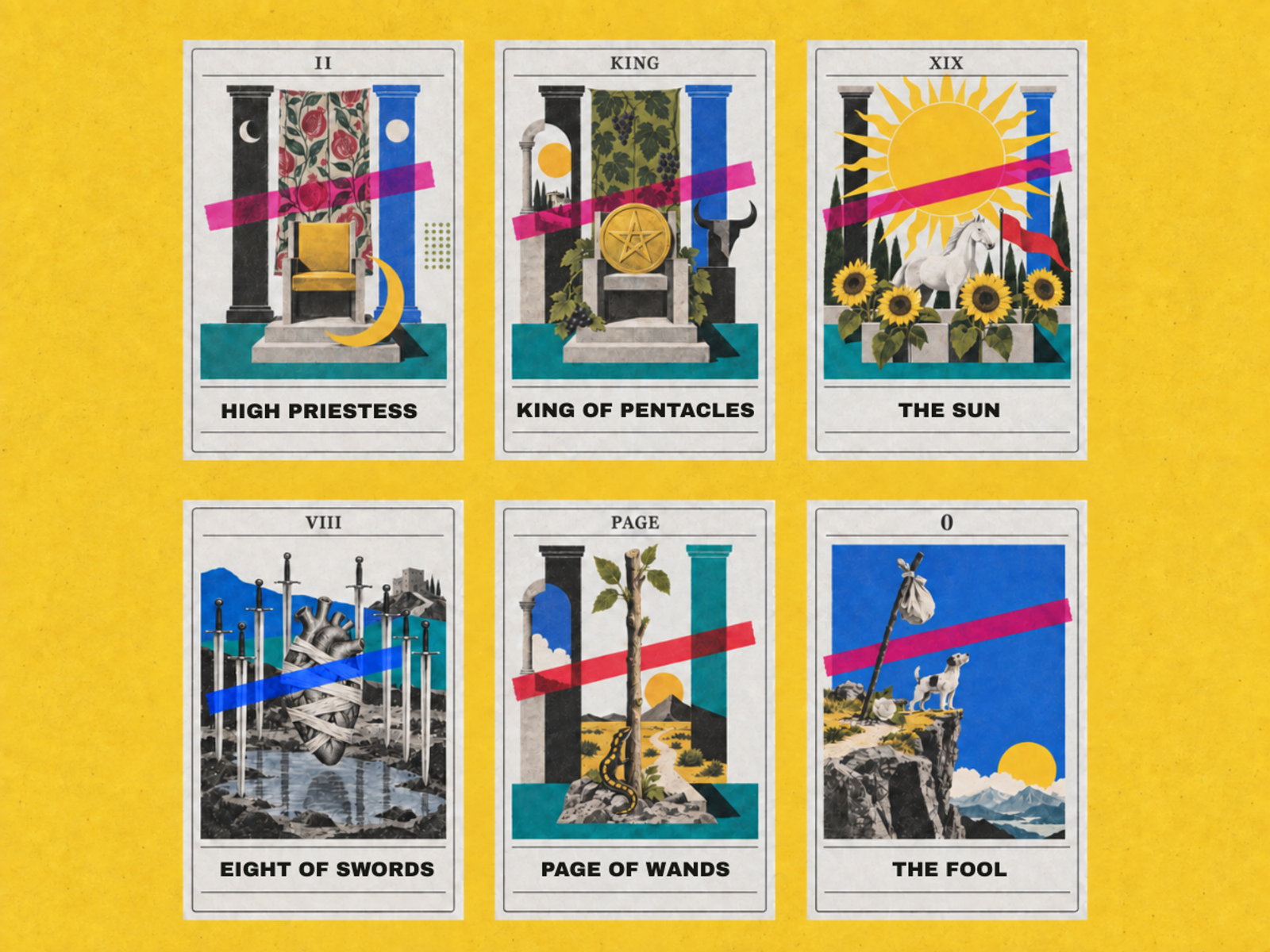
Tarot decks have become a staple of occult and esoteric practices. But beyond their reputation as fortune-telling tools, they operate through a language of symbols, archetypes, numbers, and imagery. Each card carries its own meaning, but the real complexity emerges when the cards are read together. Their positions, patterns, and relationships create a narrative that can be interpreted in countless ways. Learning tarot is less about memorizing 78 definitions and more about understanding how its symbolic language works.
Before it was an oracle
Despite what centuries of occult mythology might suggest, tarot did not arrive as an ancient tool of prophecy. The earliest surviving decks were created in fifteenth-century northern Italy as luxury playing cards. Wealthy families commissioned hand-painted sets decorated with gold leaf, courtly figures, religious imagery, and allegorical scenes.
These early decks added a sequence of illustrated trump cards to the four suits already used in Italian card games: Cups, Coins, Swords, and Batons. Players used the cards for a game, not necessarily to consult fate. The Morgan Library’s Visconti-Sforza cards, among the earliest surviving examples, were made for aristocratic entertainment. The tarot’s familiar structure had begun to form, but its mystical reputation had not. That came later.
In eighteenth-century France, the scholar Antoine Court de Gébelin proposed that tarot concealed fragments of ancient Egyptian wisdom. There was no historical evidence to support his claim, but the theory took hold. The occultist Jean-Baptiste Alliette, better known as Etteilla, went further. He developed systematic meanings for the cards, published instructions for reading them, and produced a deck designed specifically for divination. During the nineteenth century, occultists increasingly connected tarot to astrology, numerology, Kabbalah, and other esoteric systems.
In 1909, the Rider-Waite-Smith tarot deck brought these occult traditions into a new visual language. Conceived by mystic Arthur Edward Waite and illustrated by artist Pamela Colman Smith, the deck featured fully illustrated scenes on all 78 cards. Unlike earlier decks, which typically depicted the numbered Minor Arcana cards with arrangements of suit symbols, Smith's illustrations gave each card a narrative of its own. Those images made the cards easier to interpret intuitively and helped establish the visual language of modern tarot.
The cards were no longer only a game. They had become a language.
The anatomy of a tarot deck
Most contemporary tarot decks contain 78 cards divided into two sections: the Major Arcana and the Minor Arcana. The 22 Major Arcana cards include tarot’s most recognizable figures and events: The Fool, The Lovers, Death, The Devil, The Tower, The Sun, and The World.
The word arcana means secrets or mysteries. The term was introduced through tarot’s later occult tradition, not its original card-playing history. Still, it captures the way these cards now function. The Major Arcana represent archetypal figures, forces, and experiences related to identity, initiation, rupture, transformation, temptation, and awakening.
The 56 Minor Arcana cards resemble a conventional playing-card deck. They are divided into four suits, each containing ten numbered cards and four court cards.
In the Rider-Waite-Smith tradition, the system most commonly taught in the English-speaking tarot world, the suits are generally read as:
- Cups: emotion, intimacy, intuition, relationships
- Pentacles: money, work, the body, material life
- Swords: thought, communication, truth, conflict
- Wands: desire, action, creativity, ambition
These correspondences are conventions, not laws of nature. Different decks and traditions rename the suits, rearrange their associations, or emphasize different meanings. Tarot is a language with dialects. The numbers of the Minor Arcana add another layer to its translation.
“The deck may contain 78 cards, but it does not contain only 78 meanings. Each reading rearranges the vocabulary. Each reader develops a dialect.”
The deck is speaking
Learning tarot is often presented as an enormous memorization task. Seventy-eight cards, upright meanings, reversed meanings, astrological correspondences, elemental associations, and symbols hiding inside other symbols.
Memorization is one way to learn, but it is not the only way. A card does not function like a vocabulary word with one correct definition. The cards have a variety of meanings depending on the lens through which you view them. When pulling a card, consider the question you're asking, the spread you're using, and whom the question concerns.
Consider The Hermit. Alone, the card might suggest solitude, introspection, wisdom, withdrawal, or the need to search by oneself. Beside the Three of Cups, a card associated with friendship and celebration, The Hermit might indicate feeling alone in a group. It could suggest declining an invitation, needing recovery after too much socializing, or recognizing that your friends cannot solve a particular problem for you.
Beside the Eight of Pentacles, which often depicts careful, repetitive work, The Hermit might describe private study, mastery developed away from public view, or the lonely portion of becoming good at something. The card remains the same, but the meaning changes.
This is why tarot became a language rather than a static collection of symbols. Each card carries a field of possible meanings. The question, position, surrounding cards, deck imagery, and reader all help determine which meaning becomes relevant.
The Major Arcana are the plot
The Major Arcana are frequently arranged as a symbolic journey beginning with The Fool and ending with The World. The Fool steps forward with almost nothing. Along the way, they encounter authority, desire, discipline, surrender, consequence, loss, revelation, and renewal. By The World, the cycle reaches completion, only to begin again.
This sequence is often called “The Fool’s Journey.” It is a modern interpretive framework rather than the confirmed original intention of the Renaissance card makers, but it remains useful because it turns the Major Arcana into a map of experience.
In a reading, a Major Arcana card can feel like a change in scale, shifting attention from everyday circumstances to the larger themes shaping them. Let’s say you are asking specifically about your finances and pull a Major Arcana card: The Devil. This might suggest feeling trapped by financial obligations, developing an unhealthy attachment to money, or allowing financial concerns to dictate your decisions.
Where the Major Arcana suggest the larger themes at play, the Minor Arcana bring those themes into everyday life.
The Minor Arcana are the details
If the Major Arcana provide the plot, the Minor Arcana fill in the details. Think people, circumstances, decisions, and emotions. Their four suits represent broad categories of experience, while their numbers suggest how those experiences develop and unfold.
The suits are often interpreted through elemental associations:
- Wands: Fire, representing action, ambition, creativity, and drive.
- Pentacles: Earth, representing material resources, work, stability, and the physical world.
- Cups: Water, representing emotions, relationships, intuition, and connection.
- Swords: Air, representing thought, communication, conflict, and decision-making.
But the interpretation doesn't stop at the suit. Tarot readers may also draw on other esoteric practices to uncover additional layers of meaning. For example, Numerology assigns symbolic meanings to numbers. When applied to tarot, a card's numerical value can help explain how the energy of its suit develops or changes.
Here is a quick guide to the numerical symbolism commonly associated with the Minor Arcana:
- Ace (One): Beginnings, potential, opportunity, or initiation.
- Two: Duality, partnership, choices, or tension.
- Three: Growth, expansion, creativity, or collaboration.
- Four: Stability, structure, foundations, or restriction.
- Five: Disruption, conflict, change, or instability.
- Six: Adjustment, harmony, recovery, or transition.
- Seven: Assessment, challenges, reflection, or perseverance.
- Eight: Movement, mastery, effort, or restriction.
- Nine: Culmination, fulfillment, independence, or nearing completion.
- Ten: Completion, culmination, fulfillment, or excess.
The remaining sixteen cards are the court cards: Pages, Knights, Queens, and Kings, with one of each in every suit. Depending on the reading, they may represent actual people, personality traits, social roles, stages of development, or different ways of approaching a situation.
- Pages: Curiosity, beginnings, learning, exploration, and untapped potential.
- Knights: Action, pursuit, ambition, movement, and the drive to achieve.
- Queens: Maturity, intuition, receptivity, nurturing, and inner mastery.
- Kings: Authority, leadership, responsibility, experience, and outward mastery.