

You have probably been warned about a planet going retrograde.
Mercury retrograde gets blamed for missed trains, broken laptops and late night texts sent. Venus retrograde gets attached to exes resurfacing. Mars retrograde sounds vaguely threatening even if you have no idea what it means.
But before retrograde became an astrological shorthand for something is off, it described something you could actually watch happen in the night sky.
And no, the planets are not actually reversing direction.
What is a retrograde?
Normally, the planets appear to travel through the zodiac in one direction. Astronomers call this prograde motion. Every so often, though, a planet appears to slow down, stop and begin moving backward against the background of stars. Then, it slows again, stops and resumes its usual direction. That apparent backward stretch is retrograde motion.
The important word here is apparent. A retrograde planet has not thrown its orbit into reverse. It is still moving around the Sun in the same direction it was before. What changes is our perspective from Earth. Imagine driving down a highway and passing a slower car. For a moment, if you look out the window, the other car can seem like it is sliding backward. It isn't. You are both still moving forward. Your position relative to each other has changed.
Planetary retrogrades work on a much larger scale. Earth and the other planets orbit the Sun at different speeds and distances. As those positions shift, our line of sight shifts with them. From Earth, that can make another planet appear to retrace its path across the sky. So the planet never changed direction, our point of view did.
That visual reversal eventually acquired symbolic meaning in astrology. If a planet appears to turn back, astrologers read its territory as doing something similar: revisiting, reviewing or reconsidering rather than simply pushing forward.
Which planets can go retrograde?
Almost all of them. Mercury, Venus, Mars, Jupiter, Saturn, Uranus, Neptune and Pluto can all appear retrograde from Earth. The Sun and Moon cannot, they are not planets astronomically, although astrology traditionally groups the Sun, Moon and planets together as celestial bodies used in a chart. Neither the Sun nor Moon appears to reverse direction through the zodiac.
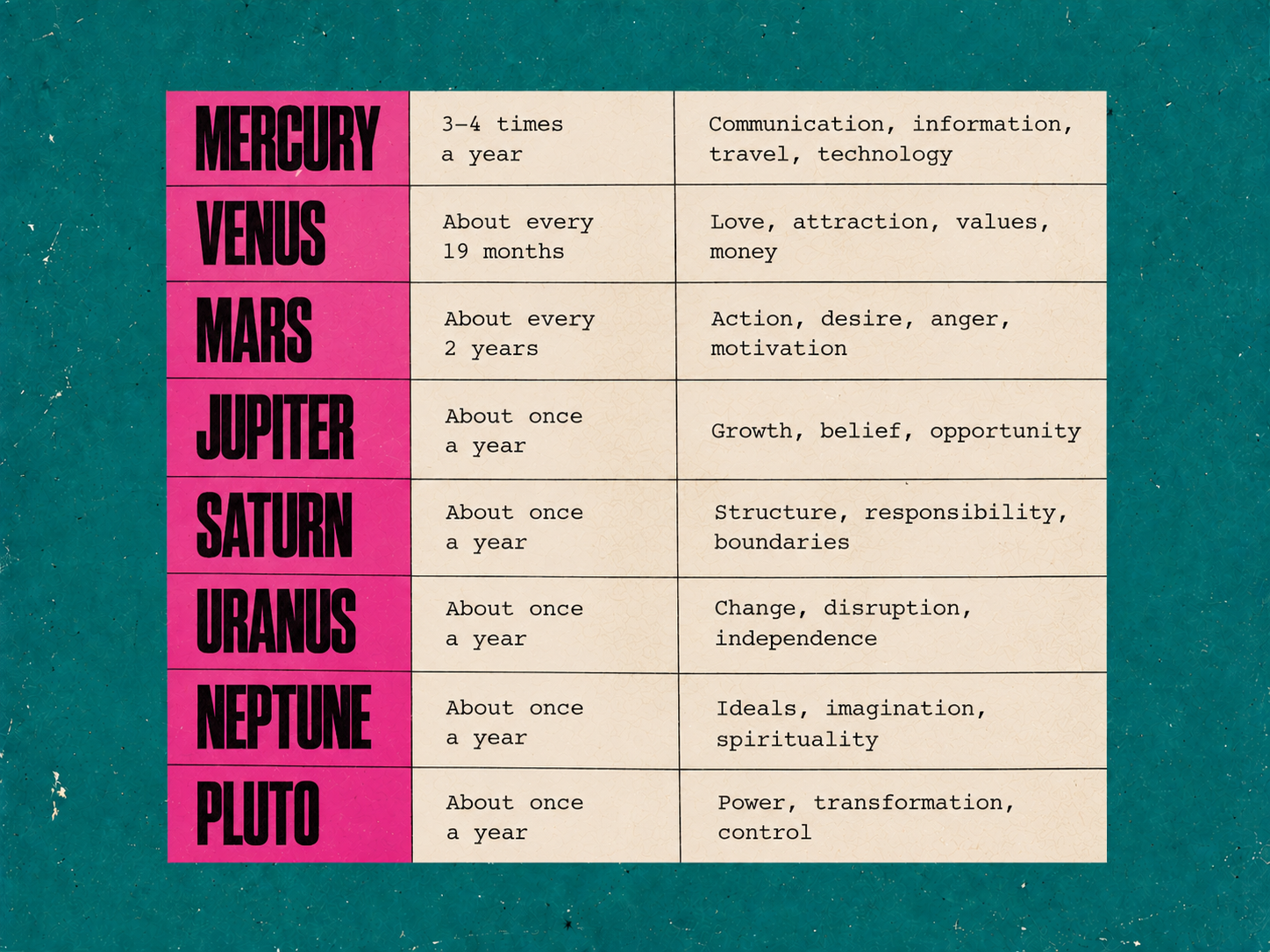
Not all retrogrades behave the same way, either. Mercury goes retrograde three or four times most years, which is one reason you hear about it constantly. Astrologically, Mercury is associated with communication, information, transportation, technology and the way we process things.
Venus goes retrograde roughly every 19 months. Its territory includes relationships, attraction, pleasure, values and money. Mars retrogrades roughly every two years. Mars is associated with action, ambition, conflict, anger and desire. Then there are Jupiter, Saturn, Uranus, Neptune and Pluto, which retrograde for months at a time during their regular cycles. That distinction matters.