
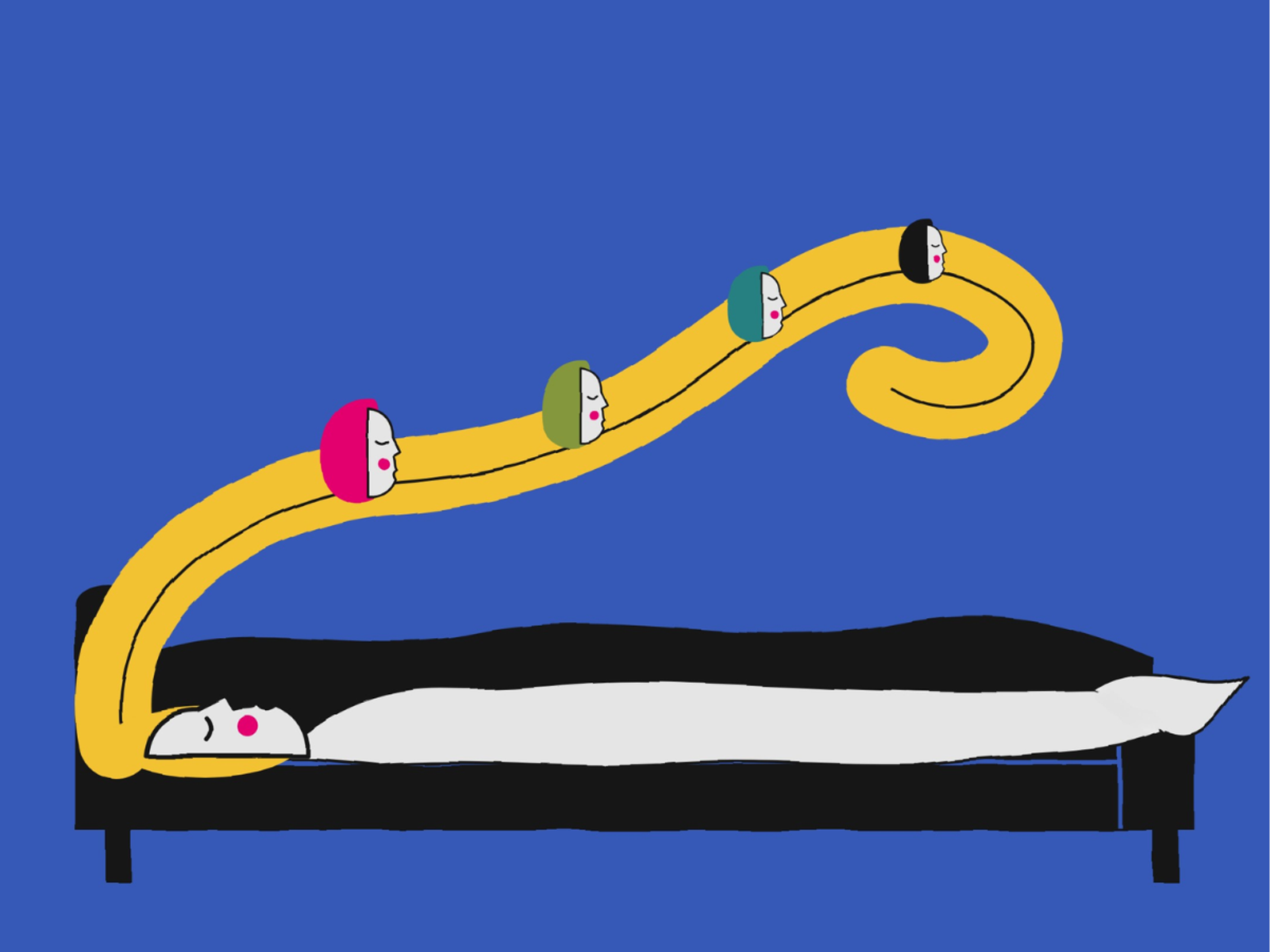
“She next found herself floating above her body, observing the scene below. She drifted up to the clouds, feeling perplexed and confused. Soon she felt herself being pulled into a ‘tiny, warm’ space. She was about to be born.” — Dr. Brian L. Weiss, Many Lives, Many Masters (1988)
In Many Lives, Many Masters, psychiatrist Dr. Brian L. Weiss recounts a series of hypnosis sessions with a patient he calls “Catherine.” What begins as a Hail Mary attempt to treat a young woman's debilitating anxiety becomes something neither of them had anticipated: a journey through past lifetimes that forces the doctor to become the patient.
Published in 1988, the book challenged the boundaries between conventional psychotherapy and spiritual belief. Weiss, a physician trained at Columbia University and Yale Medical School, had spent his career studying the human mind through medicine and science. Reincarnation was not part of his treatment plan. Until suddenly, it was.
What the hell happened on that couch?
When Catherine first arrived at Weiss's office, she was suffering from a collection of fears that had dictated her life. She was terrified of everything from water, choking, airplanes, darkness, and of course, death. Her anxiety was so severe that it bled into all areas of her existence. Weiss approached her symptoms as he would those of any other patient. He believed that identifying the origins of her fears, particularly traumatic experiences from childhood, might help alleviate them.
For months, they worked through her personal history using conventional psychotherapy. Catherine could recall certain distressing experiences, but these memories did not adequately explain the severity of her symptoms. Eventually, Weiss turned to hypnosis. Hypnotic regression was not an attempt to contact spirits or access a previous existence. Its purpose was to help Catherine retrieve childhood memories that might have been inaccessible to her conscious mind.
Under hypnosis, Weiss could guide Catherine toward earlier experiences and ask her to describe what she encountered. He hoped that revisiting the original source of her fears would help her understand and overcome them. Until one session, when he instructed Catherine to return to the time from which her symptoms originated. Instead of describing her childhood, Catherine began speaking about life in an ancient setting. She identified herself as “Aronda”, a young woman living in a village, and described a catastrophic flood in which she and her child drowned. Weiss had asked her to return to the source of her fears, which apparently brought Catherine to thousands of years before her birth.
The psychiatrist was skeptical. He initially considered whether her descriptions could be influenced from media, dreams, or material emerging from her unconscious mind. But Catherine continued to report unfamiliar identities, places, relationships, and deaths with such specificity that it was hard to deny the truth of it. Things Catherine had no knowledge of in her waking life, she would suddenly present as an expert on under hypnosis, when related to a past profession or experience.
What’s even more curious is that her symptoms began to improve. As her subconscious mind took her through the trials and tribulations of her current and past life traumas, she worked through her fear and anxiety. Hypnosis was no longer merely following the treatment plan; it was the treatment.
What is reincarnation?
Reincarnation is the belief that the soul of a person transcends physical death and returns to experience another lifetime, or “incarnation.” Rather than viewing birth and death as the absolute beginning and end of existence, reincarnation places them within a larger cycle. A person may inhabit different bodies, live under different circumstances, and encounter new relationships, all while retaining an underlying spiritual identity.
In Many Lives, Many Masters, Weiss gradually comes to interpret Catherine's experiences through this framework. Catherine had been raised in a conservative Catholic family. Her understanding of the afterlife involved heaven, hell, and purgatory, not the repeated return of a soul to Earth. Weiss specifically notes that she had little familiarity with reincarnation and had not been interested in occult or metaphysical literature.
Weiss was hardly a believer himself. His medical training had encouraged him to understand psychological suffering through observable symptoms, life experiences, and the workings of the brain. He had no intention of using reincarnation as a therapeutic tool. Yet the experiences Catherine described were not limited to past lives.
During their sessions, she would remain in a separate space between her accounts of death and rebirth, entering another state of consciousness. Weiss understood this as a space between physical incarnations, where the soul existed independently of the body. It was here that Catherine began communicating messages attributed to spiritually advanced beings Weiss called the “Masters”. According to the accounts, these beings offered teachings about the nature of the soul, the purpose of human existence, and the lessons people must learn through successive lifetimes. In these quick moments when the Masters would channel through Catherine, they spoke directly to Weiss. Catherine often remembered parts of her hypnosis sessions, but never did she recall when the Masters spoke through her. In the book, it is claimed that the information shared by them was for Weiss specifically, so she did not need to know or remember it.